
A cereal bowl can look perfectly suitable in a product photo and still be the wrong size once it reaches the breakfast table. Sometimes the opening is too narrow for adding fruit. In other cases, the bowl holds enough dry cereal but leaves little room for milk. These details may seem minor when ordering samples, but they become more noticeable when hundreds or thousands of bowls are used every day.
Most cereal bowls are sold in capacities ranging from 12 oz to 24 oz. The actual dimensions, however, vary considerably depending on the shape and intended use. For foodservice businesses and packaging distributors, choosing a suitable size means looking beyond the capacity printed on a specification sheet.

What Are the Common Dimensions of a Cereal Bowl?
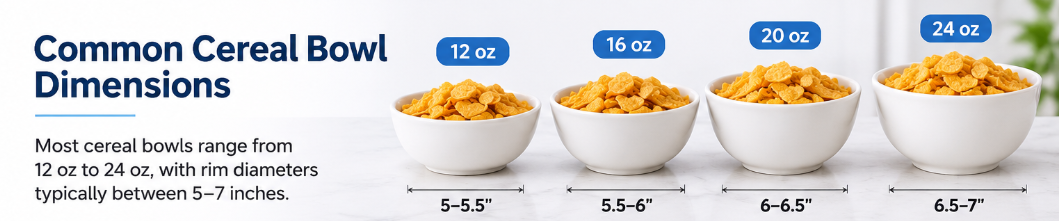
A standard household cereal bowl commonly holds around 12–20 oz, while larger options of 24 oz or more are also available for generous servings and foodservice applications. The rim diameter and height usually increase with capacity, although there is no universal sizing rule.
The following measurements provide a general reference when comparing products:
|
Capacity |
Approx. Rim Diameter |
Typical Use |
|---|---|---|
|
12 oz |
5–5.5 inches |
Small cereal servings |
|
16 oz |
5.5–6 inches |
Everyday breakfast |
|
20 oz |
6–6.5 inches |
Cereal with toppings |
|
24 oz |
6.5–7 inches |
Large portions |
These figures are indicative rather than fixed specifications. A deep 16 oz bowl can have a smaller opening than a shallow bowl with the same capacity. Some manufacturers also measure capacity by filling the bowl completely to the rim, which is not necessarily how anyone would use it.
When comparing products from different custom cereal bowl manufacturers, it is worth requesting the rim diameter, base diameter, overall height, and usable capacity separately. Looking at capacity alone can make two quite different designs appear identical.
How Much Space Do Cereal and Milk Actually Need?
Consider a breakfast serving containing corn flakes, milk, and a handful of sliced bananas. The dry cereal may initially seem to take up very little room, but once the milk is poured in, the bowl needs enough additional space for stirring and eating.
Granola creates a different situation. Its clusters, nuts, and seeds can occupy more space than expected, particularly when served with yogurt and fruit. A bowl selected for ordinary corn flakes may therefore feel cramped when used for a more substantial breakfast combination.
This is where usable capacity becomes more relevant than maximum capacity. Filling a bowl right up to the rim might produce an impressive specification, but it leaves little room for normal handling.
For an OEM cereal bowl manufacturer, understanding the customer’s actual serving combination is often more useful than receiving a capacity target without any explanation of the intended food.
A practical sample test does not need complicated equipment. Put the normal portion into the bowl, add the usual amount of milk or yogurt, and check whether there is enough room to mix everything without spilling. That simple exercise can reveal problems that measurements alone will not show.
Does Bowl Diameter or Depth Matter More?
Not necessarily. The difference becomes obvious when the same volume is distributed across two different shapes.
A wide, relatively shallow bowl gives cereal and toppings more room to spread out. It is convenient for adding strawberries, blueberries, nuts, or other ingredients. Customers can also reach the food without digging into a deep container. The downside is that liquid sits closer to the rim, making spills more likely if the bowl is moved carelessly.
A deeper bowl takes up less table space and can hold milk more comfortably. However, a narrow opening may make it harder to mix ingredients or reach cereal at the bottom.
The bottom diameter matters too. A bowl that narrows sharply toward its base may be easy to stack, but its internal space is distributed differently from a bowl with straighter walls. This can affect both serving capacity and stability.
For ODM cereal bowl suppliers, these structural details are worth discussing during product development. Increasing the stated capacity is not always the right answer. Sometimes a slightly wider opening or a different wall angle solves the actual problem without making the entire bowl larger.

Which Dimensions Suit Different Foodservice Applications?
The same cereal bowl does not necessarily work for every business. A hotel buffet, a neighborhood cafe, and a takeaway breakfast operation have different priorities.
Hotel Breakfast and Buffet Service
At a hotel buffet, customers often combine cereal with milk, yogurt, fruit, or nuts. A medium-to-large bowl gives them room to prepare a serving without needing to return for another container.
Staff handling is another consideration. Bowls are frequently stacked, moved, washed, and replenished throughout the morning. If nested bowls fit too tightly, separating them during a busy breakfast service becomes an unnecessary inconvenience.
For cereal bowl manufacturers for restaurant chains, consistent dimensions across production batches are particularly important. Different bowl sizes within the same service setup can affect portion presentation, storage arrangements, and replacement purchasing.
Cafes and Quick-Service Restaurants
Cafes usually build bowl sizes around their menu portions. A 16 oz option may work for a straightforward cereal serving, while a 20 oz or larger bowl may be more suitable for granola, yogurt, and fruit combinations.
The opening diameter deserves attention here. A bowl that is too narrow can make toppings difficult to arrange, even when its total capacity appears sufficient.
Retail and Takeaway Breakfast Packaging
Takeaway products introduce another issue: the lid. A bowl may hold the correct portion but still be unsuitable if its rim does not match the available lid.
For wholesale cereal bowl suppliers serving takeaway businesses, checking the complete bowl-and-lid combination is particularly important. The closure should remain secure during normal handling and transportation, rather than simply fitting when pressed onto an empty bowl.

What Should You Check Before Placing a Bulk Order?
A sample approval should involve more than checking whether the bowl looks right. The first thing to confirm is how the manufacturer measures capacity. Ask whether the stated volume is measured to the rim or represents a practical filling level.
Dimensional consistency also deserves attention. Small differences in rim diameter can cause trouble when bowls are designed for matching lids or accessories. For repeat orders, buyers should confirm the agreed dimensional tolerances and sample specifications.
Stacking is another detail that is easy to overlook. Take several samples and stack them together. Check whether they separate easily, whether the stack remains stable, and whether the bowls occupy a reasonable amount of storage space.
An experienced cereal bowl factory for bulk production should be able to provide dimensional specifications and samples for evaluation before the order moves into full production.
For businesses selling multiple breakfast products, it may also make sense to standardize a small range of bowl sizes rather than introduce a different specification for every menu item. This can simplify purchasing, storage, and inventory management.
A bulk cereal bowl supplier for catering businesses should also be able to clarify packaging quantities and stacking arrangements, since these factors influence warehouse space and delivery planning.
How Do You Specify Dimensions for a Custom Cereal Bowl?
If existing sizes do not fit the intended serving, the design should begin with the actual food portion. Decide how much cereal, milk, yogurt, or additional toppings the bowl needs to accommodate. Then work backward to establish a suitable capacity.
The rim diameter and depth can be adjusted to change how that volume is distributed. A wider opening may be preferable for fruit-heavy breakfast bowls, while a deeper profile may make more sense for liquid-based servings.
The base diameter and wall shape should not be left until the end, particularly when stackability is part of the requirement. If the bowl needs a lid, both components should be checked together during sampling.
A private-label cereal bowl manufacturer can use these requirements as a starting point for a product specification. For distributors developing their own product ranges, an OEM cereal bowl supplier for foodservice distributors can also help assess how the selected specifications translate into repeatable production.
For more specialized requirements, working with a custom cereal bowl factory allows buyers to discuss adjustments to the bowl profile, dimensions, and matching accessories. The objective is not simply to create a larger or smaller container, but to make the dimensions work with the intended food and serving process.
Ultimately, there is no single measurement that works for every cereal bowl. A 16 oz design may be perfectly adequate for one breakfast menu and completely unsuitable for another. The more reliable approach is to test the bowl with the food it will actually contain, then confirm the dimensions before committing to a large order.
