
A restaurant can go through a surprising number of plastic spoons and forks without anyone paying much attention to them. They are collected after meals, washed with the rest of the dishes, dried, and put back into the containers for the next shift. As long as there are enough utensils for the next round of customers, replacing them rarely becomes a priority.
But after months of use, the collection starts to look different. Some forks have bent slightly. A few spoons have rough edges, and others have picked up stains that never seem to disappear completely. Staff might put the worst ones aside, but there are always a few questionable pieces that find their way back into service.
For restaurant managers, the difficult part is not knowing that plastic utensils wear out. It is deciding which ones can stay and which ones have reached the end of their useful life.
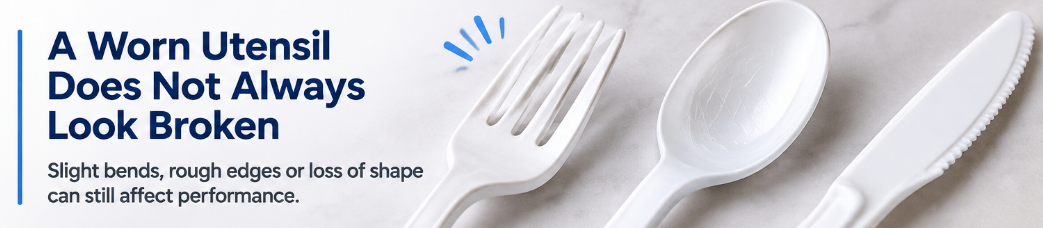
A Worn Utensil Does Not Always Look Broken

Consider a busy restaurant that uses the same style of plastic fork throughout the day. After washing, most forks still look fine. A few, however, have slightly bent tines. They have not snapped, and a quick glance might not reveal anything unusual.
During service, the difference becomes more noticeable. Customers struggle to pick up certain foods, and staff occasionally remove forks from tables because they are uncomfortable to use. These are small interruptions, but they are also signs that the utensils are no longer performing as expected.
The same thing happens with spoons. A handle that has started to twist or a bowl that has lost its shape may not look seriously damaged, yet the utensil becomes less practical.
This is worth considering when choosing a reusable plastic utensils manufacturer. A product should be judged by how it performs after repeated use, not simply by how solid it feels when taken out of a new carton.
Some Damage Is a Clear Reason to Stop Reusing Them

A restaurant does not need a complicated inspection procedure to recognize certain problems. A fork with a broken tine, a spoon with a cracked edge, or a knife with a damaged handle should not go back into the clean utensil container.
Small cracks deserve particular attention. Food residue can collect in damaged areas, making effective cleaning more difficult. Running the utensil through the dishwasher again does not restore the original surface.
Discoloration is less straightforward. A spoon used for tomato-based dishes may retain a slight orange tint even after washing. That alone does not necessarily mean it needs replacing. Persistent odors, remaining food residue, and surfaces that have become rough or difficult to clean are different matters.
Staff should also pay attention to utensils that have been exposed to excessive heat. Sometimes a spoon comes out of the dishwasher looking almost normal but no longer sits flat or stacks properly. If the shape has changed enough to affect its use, keeping it for another few weeks is unlikely to be worthwhile.
Why the Old Stock Often Stays Around
The purchasing decision is not always as simple as removing every worn utensil. Imagine a restaurant with several hundred pieces in circulation. Twenty forks are damaged, another ten have rough edges, and the rest are still working normally.
Ordering a completely new set would mean paying for many utensils that do not actually need replacing. Most operators would rather purchase a smaller quantity and keep the usable stock.
The trouble starts when nobody takes responsibility for separating the damaged pieces. During a busy lunch service, employees are more concerned with clearing tables than checking every fork. A damaged utensil may be left beside the washing area, mixed with clean stock, and eventually used again.
Restaurants purchasing reusable plastic cutlery in bulk should think about this when planning replacement orders. A small reserve of matching utensils can be more useful than waiting until an entire set becomes unusable.
There is another issue worth checking. If the same model keeps developing cracks or losing its shape, replacing individual pieces will only postpone the next problem. The restaurant needs to find out whether the product is suitable for its washing equipment and daily workload.
When a Few Damaged Pieces Point to a Bigger Problem
One broken spoon does not tell a purchasing manager very much. A dozen spoons from the same order showing similar damage is a different story.
It helps to look at where the damaged utensils came from and how they were used. Were they all washed in the same machine? Did the problem appear after a change in detergent? Are forks wearing out faster than spoons, or is the entire set showing the same signs?
These details matter because the replacement decision may involve more than ordering additional stock. If the washing temperature exceeds the product’s recommended conditions, a new batch could develop the same problems.
For a restaurant chain, comparing damage reports between branches can also be useful. One location may have utensils that remain in good condition for much longer than another. Before blaming the product, it is worth checking whether their washing and storage routines are actually comparable.
A commercial plastic cutlery supplier should be able to help clarify the product’s intended conditions of use and provide relevant specifications. Vague assurances about durability are less useful than information that can be checked against the restaurant’s actual cleaning process.
The Next Order Should Be Based on How the Utensils Are Used

When restaurants reorder, they often start with the previous purchase: the same size, the same shape, and preferably the same price. That is understandable, especially when staff already know how to handle the existing products.
Still, it is worth asking a few questions before repeating the order. Are the utensils intended for repeated commercial use? Can they tolerate the restaurant’s normal washing conditions? Has the supplier tested them under conditions similar to those used in the kitchen?
A custom reusable plastic utensils manufacturer may offer different thicknesses, shapes, or designs for particular foodservice requirements. But a thicker utensil is not automatically a better one. It needs to remain comfortable to use, easy to clean, and suitable for the available storage space.
Restaurants working with an OEM plastic cutlery factory can request samples and test them alongside their current stock. Rather than judging a new fork straight out of the package, use it through normal service and repeated washing. Check whether the shape changes, whether food residue is easy to remove, and whether the utensils still stack neatly.
For distributors supplying several restaurants, consistency between orders matters too. A bulk reusable plastic utensils supplier should be able to maintain the agreed specifications when customers need additional quantities. Otherwise, replacement stock may feel noticeably different from the utensils already in use.
A restaurant plastic utensils manufacturer for foodservice businesses should also understand that customers are not simply buying a plastic fork or spoon. They are buying something that has to fit into an existing washing, storage, and service routine.
There Is No Benefit in Keeping a Utensil That No Longer Works
Some restaurants replace utensils too early because they look old. Others keep them long after cracks, rough edges, or deformation have become obvious. Neither approach makes much sense.
A little discoloration may be acceptable, but a damaged surface or utensil that cannot be cleaned properly is not worth keeping. When the same defects appear across an entire batch, the restaurant should investigate the cause before placing another order.
The useful question is not how long a plastic utensil has been in service. It is whether that particular utensil can still do its job properly under the conditions in which the restaurant uses it.
